Kotlin Coroutines Official Library: An Elegant Revolution in Asynchronous Programming
A deep dive into kotlinx.coroutines, Kotlin's official coroutine library. Learn how it transforms asynchronous programming with lightweight, structured, and cancellable concurrency patterns. Perfect for Java developers looking to modernize their async code.
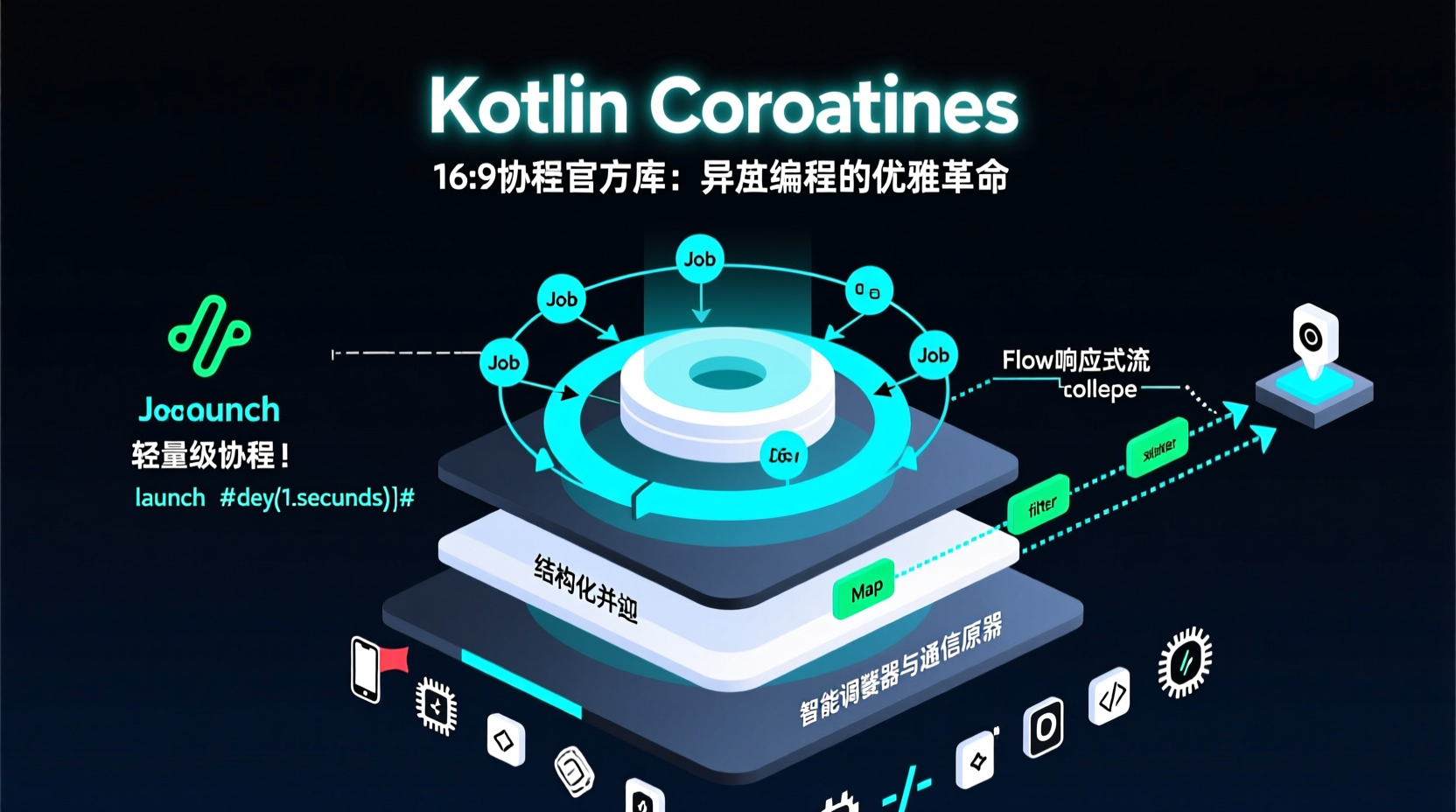
kotlinx.coroutines: Kotlin's Official Coroutine Implementation - An Elegant Solution for Asynchronous Programming
As a technical blogger with 8 years of Java backend development experience, I have to admit that Kotlin coroutines have completely transformed my understanding of asynchronous programming. Today, let's take a deep dive into Kotlin's official coroutine library—kotlinx.coroutines. This project made its debut on GitHub Trending today with 13,768 stars, and it's absolutely worth exploring in depth.
What Problem Does This Project Solve?
In traditional Java development, we typically have several options for handling asynchronous tasks: thread pools, callbacks, CompletableFuture, or reactive programming frameworks like RxJava. However, each of these approaches has its pain points: high thread resource overhead, callback hell, poor code readability, and steep learning curves.
kotlinx.coroutines leverages Kotlin's coroutine features to provide a lightweight, structured, and cancellable asynchronous programming model. Its core philosophy is simple: write synchronous-looking code that executes asynchronously. This might sound magical, but anyone who has used it knows how powerful it is.
Core Technical Architecture Analysis
1. Coroutine Builders
The library provides two core builders: launch and async:
launchreturns aJob, used to launch coroutines that don't return resultsasyncreturns aDeferred<T>, used to launch coroutines that return results
This design reminds me of Java's Runnable and Callable, but the lightweight nature of coroutines allows thousands of them to exist simultaneously without overwhelming the system.
2. Dispatchers
The Dispatchers object provides multiple scheduling strategies:
Dispatchers.Main: For UI threads in Android/Swing/JavaFXDispatchers.Default: For CPU-intensive background tasksDispatchers.IO: For blocking I/O operations (JVM-specific)Dispatchers.Unconfined: An unrestricted dispatcher
This design is very thoughtful—developers don't need to manually manage thread pools; the framework automatically selects the optimal scheduling strategy based on task type.
3. Flow Reactive Streams
Flow is a cold asynchronous stream that supports rich operators like map, filter, reduce, and more. Compared to RxJava, Flow has a lower learning cost and integrates natively with coroutines. For scenarios requiring data stream processing, Flow is the preferred solution.
4. Channels and Synchronization Primitives
Channel, Mutex, and Semaphore provide communication and synchronization mechanisms between coroutines. These primitives draw inspiration from Go's Channel concept but are designed to fit Kotlin's language characteristics better.
Quick Start Example
The README provides a very concise example demonstrating basic coroutine usage:
kotlin
suspend fun main() = coroutineScope {
    launch {
       delay(1.seconds)
       println("Kotlin Coroutines World!")
    }
    println("Hello")
}
This code demonstrates several key points:
coroutineScopecreates a coroutine scopelaunchstarts a child coroutinedelayis a suspending function that doesn't block the thread- The structured concurrency relationship between parent and child coroutines
Project Dependency Configuration
Gradle Configuration (Recommended)
kotlin
dependencies {
    implementation("org.jetbrains.kotlinx:kotlinx-coroutines-core:1.11.0")
}

plugins {
    kotlin("jvm") version "2.2.20"
}

repositories {
    mavenCentral()
}
Special Notes for Android Projects
If using in an Android project, you need to add the Android module:
kotlin
implementation("org.jetbrains.kotlinx:kotlinx-coroutines-android:1.11.0")This module provides the Android platform's Dispatchers.Main implementation and ensures that unhandled exceptions are properly logged rather than crashing the application directly.
Use Case Analysis
Based on my actual project experience, kotlinx.coroutines is particularly well-suited for the following scenarios:
- High-Concurrency Network Requests: The lightweight nature of coroutines makes it easy to handle thousands of concurrent requests
- Batch Database Operations: When paired with Room or Exposed, you can elegantly handle asynchronous database operations
- Real-Time Data Processing: Flow is ideal for processing real-time data streams, such as WebSocket messages or sensor data
- Android UI Programming: Coroutines + Flow has become the standard paradigm for Android development
- Microservice Communication: In Spring WebFlux or Ktor, coroutines can simplify asynchronous code
Limitations and Considerations
Of course, there's no silver bullet, and coroutines have some aspects to keep in mind:
- Learning Curve: While simpler than RxJava, concepts like
suspend,coroutineScope, andSupervisorJobstill take time to understand - Debugging Complexity: Coroutine stack traces are less intuitive than thread traces; you'll need the
kotlinx-coroutines-debugmodule - Integration with Existing Code: If your project heavily uses callbacks or CompletableFuture, mixing approaches will increase complexity
- Performance Overhead: Although lightweight, coroutine switching still has minor overhead; extreme high-performance scenarios require evaluation
Multi-Platform Support
One of the project's highlights is its multi-platform support. Beyond JVM, it also supports:
- Kotlin/JS: Seamless integration with Promises
- Kotlin/Native: Supports iOS, macOS, Linux, and other native platforms
This means you can write cross-platform applications using the same coroutine code, significantly improving code reuse.
Conclusion
kotlinx.coroutines is an indispensable infrastructure in the Kotlin ecosystem. It encapsulates the complexity of asynchronous programming beneath a简洁 API, allowing developers to focus on business logic rather than thread management. For Java developers, transitioning from the traditional thread model to the coroutine model is an investment worth making.
If you haven't used coroutines in your projects yet, I strongly recommend starting with a small module. Trust me, once you get used to the feeling of writing asynchronous logic with sequential code, there's no going back.
Current Version: 1.11.0 | Kotlin Version Requirement: 2.2.20 | License: Apache 2.0