Bytebase: A Practical Analysis of the 18K+ Star Database DevOps Platform
An in-depth look at Bytebase, the only database CI/CD open source project in the CNCF Landscape, exploring how it solves real-world database schema management challenges through GitOps workflows.
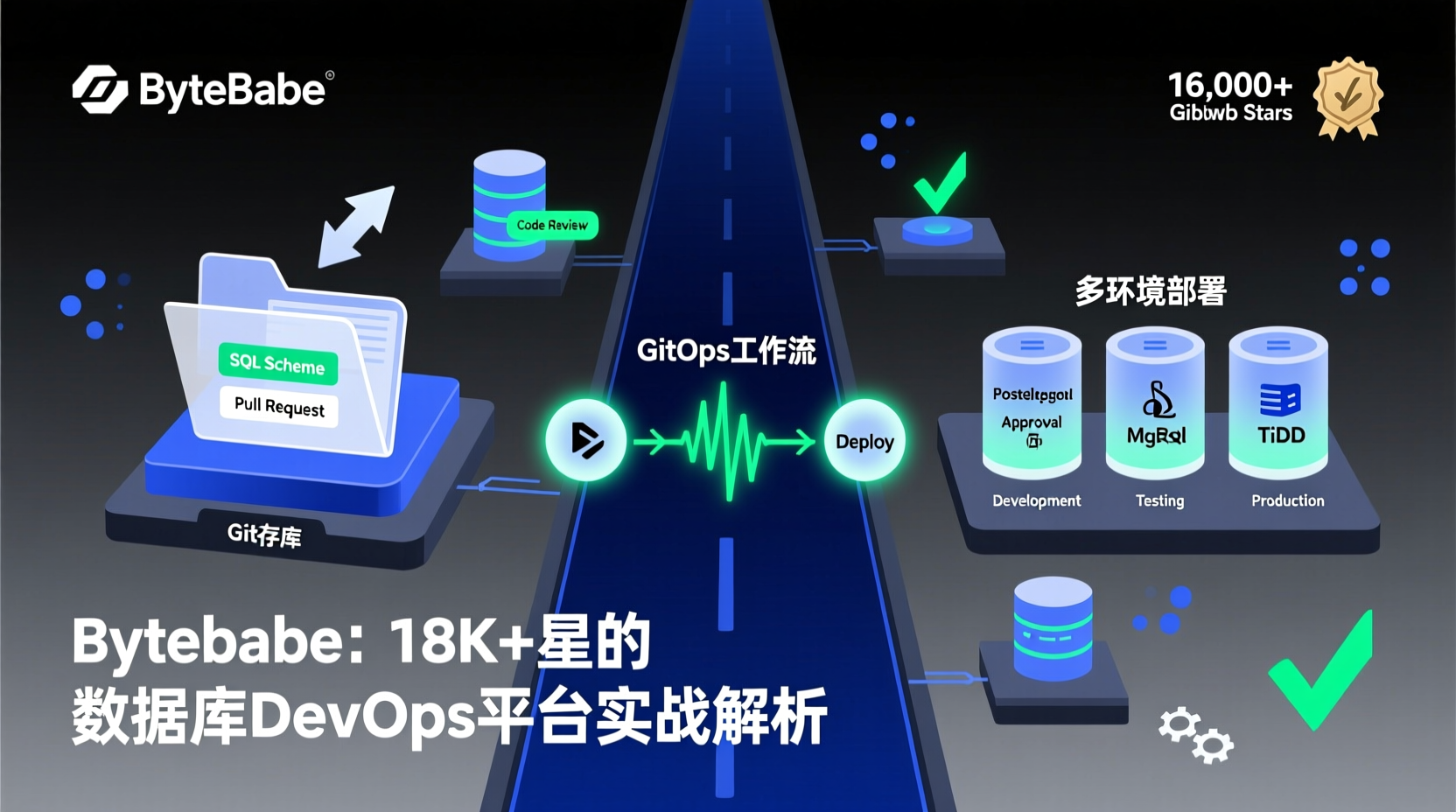
Bytebase: What Problems Does This 18K+ Star Database DevOps Platform Actually Solve?
Hi everyone, I'm Zhou Xiaoma. Today I want to talk about a treasure project I discovered during my database toolchain research—Bytebase. As a developer with 8 years of Java backend experience, I'm all too familiar with the pain points in database change management:不敢 executing DDL directly in production, multi-environment synchronization errors, difficult collaboration between DBAs and developers... Bytebase provides its own answers to all these problems.
1. Real-World Problems Bytebase Solves
In traditional development workflows, database schema changes are often one of the most error-prone steps. I've seen too many teams cause production incidents due to lack of standardized change processes: developers executing incorrect ALTER statements directly on test databases, DBAs missing certain fields during manual synchronization, emergency fixes bypassing approval to directly modify production...
Bytebase's positioning is very clear—a database CI/CD platform. It's the only database CI/CD open source project currently included in the CNCF Landscape and Platform Engineering toolchain, and this identity alone speaks to its technical value.
Its core value lies in incorporating database changes into standard DevOps workflows: managing database schemas through GitOps, with version control, code review, and automated deployment just like code. For teams pursuing Infrastructure as Code (IaC), this completes the puzzle.
2. Core Technical Architecture Analysis
Bytebase is developed in Go, a common choice for high-performance backend services. From an architecture perspective, it's a typical cloud-native multi-tenant SaaS architecture that supports self-hosted deployment.
Backend Technical Features
- Multi-Database Adaptation Layer: Bytebase supports PostgreSQL, MySQL, MariaDB, TiDB, Snowflake, ClickHouse, MongoDB, Redis, Oracle, SQL Server, Spanner, and more than a dozen other databases. This means it must have a powerful abstraction layer internally to uniformly handle SQL syntax differences and metadata management across different databases.
- SQL Lint Engine: Built-in with 200+ SQL Lint rules that can intercept non-compliant SQL statements at the submission stage. This feature is very useful for enforcing team SQL standards, such as禁止 DROP TABLE without WHERE conditions, mandatory comments, etc.
- Audit Log System: All database operations have complete audit records to meet compliance requirements.
GitOps Workflow
Bytebase's GitOps integration is its biggest highlight. It natively integrates with GitHub/GitLab, supporting the database-as-code workflow model. Specifically, you can place database schema definitions in a Git repository, trigger change reviews through Pull Requests, and automatically or manually deploy to target environments after approval.
The benefits of this model are obvious: database changes have complete version history, changes are traceable, and rollback is supported.
3. Installation and Quick Start
Bytebase installation is very user-friendly. The official provides both Docker and Kubernetes deployment methods. Here's the Docker quick start command:
bash
docker run --init \
  --name bytebase \
  --publish 8080:8080 \
  --volume ~/.bytebase/data:/var/opt/bytebase \
  bytebase/bytebase:latest
After startup, visit http://localhost:8080 to enter the configuration wizard. For Kubernetes users, official Helm Chart is also available:
bash
helm install bytebase bytebase/bytebaseThis deployment method is very friendly to DevOps teams and can be directly integrated into existing CI/CD pipelines.
4. Use Cases and Limitations
Applicable Scenarios
-
Multi-Environment Database Management: If you have multiple environments like development, testing, staging, and production that need unified schema change control, Bytebase's batch change feature can apply one operation to multiple environments at once.
-
Team Collaboration Needs: When DBAs and developers need to work together, Bytebase's SQL Review, permission control, and approval workflows can effectively standardize collaboration processes.
-
Scenarios with Strict Compliance Requirements: Industries like finance and healthcare have strict audit requirements for data operations. Bytebase's complete audit logs and fine-grained RBAC permission control can meet these needs.
-
Multi-Tenant SaaS Architecture: Bytebase supports tenant-level database management, suitable for SaaS providers managing hundreds or thousands of customer databases.
Limitation Analysis
Of course, Bytebase is not a silver bullet. Based on my usage experience, there are a few points to note:
- Learning Curve: For developers accustomed to directly connecting to databases to execute SQL, adapting to the new workflow is required. Teams need some training and a settling-in period.
- Performance Overhead: As a middleware layer, Bytebase introduces certain performance overhead. For ultra-high concurrency scenarios, evaluation is needed to determine suitability.
- Specific Database Feature Support: While supporting multiple databases, certain advanced features of specific databases may not be fully supported and need evaluation based on the actual database types in use.
5. Developer Experience and Extensibility
Bytebase provides rich APIs and Terraform Provider that can be seamlessly integrated into existing automation workflows. For teams that like Infrastructure as Code, you can directly manage Bytebase resources with Terraform.
Local development environment setup is also relatively simple, with clear guidance from the official:
bash
## Set up PostgreSQL database
export PG_URL=postgresql://bbdev@localhost/bbdev

## Start backend
alias r='go build -ldflags "-w -s" -p=16 -o ./bytebase-build/bytebase ./backend/bin/server/main.go && ./bytebase-build/bytebase --port 8080 --data . --debug'

## Start frontend
alias y="pnpm --dir frontend i && pnpm --dir frontend dev"
From the development configuration, it's clear that Bytebase backend relies on PostgreSQL for metadata storage, and the frontend uses modern frontend toolchains (pnpm). The technology choices are quite reasonable.
6. Comparison with Other Tools
The official documentation lists comparisons with tools like Liquibase, Flyway, DBeaver, and DataGrip. Simply put:
- vs Liquibase/Flyway: Bytebase not only supports schema migration but also provides a complete management interface, collaboration workflows, and SQL audit capabilities
- vs DBeaver/DataGrip: Bytebase focuses more on team collaboration and process control rather than individual development tools
- vs Navicat: Bytebase is open source and focuses on DevOps workflows rather than purely management tools
Summary
As an open source project with 18K+ stars, Bytebase has indeed made a difference in the database DevOps field. Its GitOps philosophy, comprehensive audit system, and multi-database support make it a good choice for database governance in medium to large teams.
If you're struggling with database change management or want to incorporate databases into standard CI/CD workflows, Bytebase is worth your time to try. Of course, tools are just tools—the key is to establish standardized processes that fit your team.
Note: Code examples analyzed in this article are from the official README. Please refer to the latest documentation for actual use.