Building Recommender Systems with Python: Best Practices
'recommenders': Linux Foundation AI & Data Project-backed open-source toolkit providing full workflow support for recommender system development from data preprocessing to model deployment. Addresses challenges in building from scratch, algorithm selection, evaluation; covers 5 key tasks including data preparation, with standardized tools, examples, MovieLens support, 20k+ stars, a mature solution.
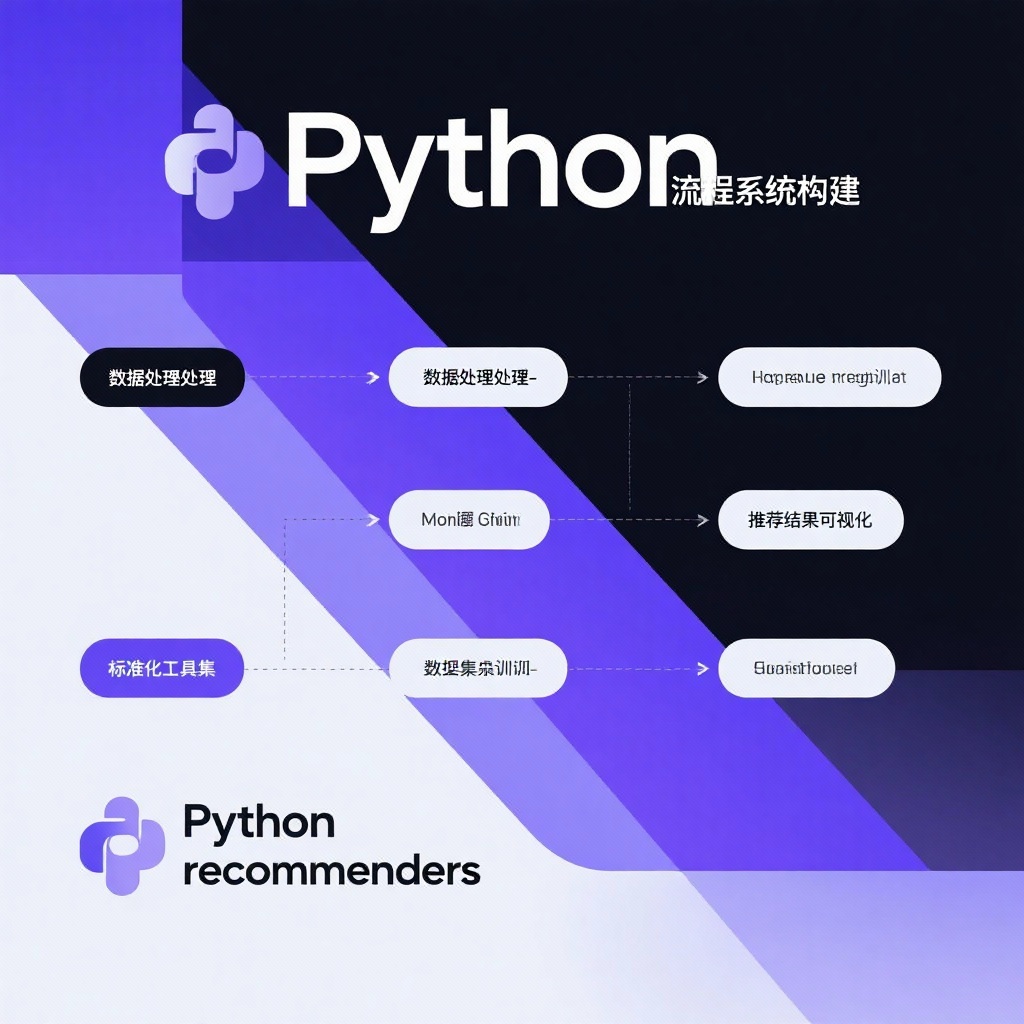
recommenders: A Comprehensive Toolkit for Recommender System Development
If you're a developer tasked with building a recommender system, you've likely faced challenges: from data preprocessing to model selection, from performance evaluation to production deployment, each环节 requires building from scratch. Algorithm selection is difficult, evaluation standards are inconsistent, and deploying models to production environments can be particularly challenging. The recommenders project on GitHub was created to address these pain points. Supported by the Linux Foundation AI & Data project, this open-source toolkit brings together best practices in recommender system development, offering end-to-end support from data preparation to model deployment. With over 20,000 stars, it has established itself as a mature practical project in the recommender system domain.
Core Features: Covering the Entire Recommender System Development Lifecycle
The core value of recommenders lies in being not just a single algorithm implementation, but a complete recommender system development framework. It breaks down recommender system development into five key tasks, providing standardized tools and examples for each:
Data preparation is the first and often most time-consuming step in recommender system development. The project offers tools for data loading, cleaning, and format conversion, supporting common datasets like MovieLens, Amazon Reviews, and MIND news. It can quickly transform raw data into input formats required by different algorithms. For implicit feedback data, it provides preprocessing functions like negative sampling and interaction matrix construction, eliminating the need for repetitive work.
Model building is the centerpiece of the project, covering various algorithms from traditional methods to deep learning approaches. Among traditional methods, you'll find Spark MLlib's ALS (suitable for large-scale data) and SAR (a lightweight, efficient collaborative filtering algorithm developed by Microsoft). For deep learning, it includes NCF (Neural Collaborative Filtering), LightGCN (Graph Neural Network recommendation), SASRec (Transformer model for sequential recommendations), and more. Notably, each algorithm comes with Jupyter Notebook examples that provide detailed explanations from basic principles to code implementation. Topics like distributed training and parameter tuning for ALS, and graph construction for LightGCN can be quickly mastered through these examples.
The evaluation and optimization components are equally practical. The project provides unified tools for calculating evaluation metrics, supporting ranking metrics such as precision, recall, and NDCG, as well as rating prediction metrics like RMSE and MAE. It also includes built-in benchmarking for algorithm comparison. For instance, the benchmark module can automatically run multiple algorithms on the MovieLens dataset and output performance comparison tables, helping developers intuitively select models suitable for their scenarios. From official comparison data, BiVAE shows outstanding performance in MAP and NDCG@k, while SAR excels in training speed—these empirical results offer more practical value than theoretical papers alone.
Production deployment support is what distinguishes this project from purely academic ones. It provides Azure deployment tutorials covering model serialization, API packaging, A/B testing design, and even best practices for model monitoring and updates—extremely valuable for teams needing to implement recommender systems in production.
Technical Highlights: Balancing Academic Frontiers and Engineering Practice
The technical design of recommenders has several noteworthy aspects. First is its multi-environment support, with algorithm implementations considering different hardware conditions: basic algorithms run on CPU, deep learning models support GPU acceleration, and distributed scenarios are adapted for Spark. Developers can choose the appropriate solution based on their resources. For example, LightGBM offers both single-machine CPU and PySpark distributed implementations, facilitating the transition from prototype to large-scale deployment.
Second is its attention to engineering details. Each algorithm implementation includes optimizations, such as efficient computation for sparse data in SAR and adjacency matrix optimization in LightGCN—details often overlooked in academic papers but directly impacting real-world performance. Additionally, it provides data splitting tools supporting temporal splitting (more aligned with actual recommendation scenarios) and stratified sampling, avoiding evaluation bias caused by improper data splitting.
Compared to similar projects like DeepRec (focused on deep learning recommendations) or the lightweight Cornac, recommenders优势在于 its end-to-end coverage. While other projects focus primarily on model implementation, recommenders handles everything from data to deployment, making it more suitable for end-to-end development. For example, although Cornac includes various collaborative filtering algorithms, it lacks data preprocessing and deployment guidance. In contrast, recommenders "scenarios" directory provides complete case studies for specific applications like news recommendation and product recommendation, essentially offering reusable solutions.
Practical Experience: Who is it For?
Using recommenders requires a certain level of Python proficiency and basic knowledge of recommender systems. The official documentation recommends using conda for environment management, with clear installation commands. However, some algorithms have numerous dependencies (like Spark and GPU versions of TensorFlow), which may require time to configure. Once the environment is set up, following the example notebooks allows you to implement a basic recommender system quickly.
In my personal testing, I ran both SAR and NCF models on the MovieLens-100K dataset. SAR trained quickly, producing results in minutes on a regular CPU—ideal for rapid idea validation. As a deep learning model, NCF required GPU acceleration but achieved around 0.39 NDCG@k after parameter tuning, which aligned with expectations. The project's evaluation functions are also convenient, outputting multiple metrics with a single line of code and eliminating the need to write custom evaluation scripts.
However, it has some limitations. First, regarding update frequency, while version 1.2.1 was released in April 2025, some cutting-edge algorithms (like LLM-based recommendations) are not yet included, making it more suitable for classic scenarios than前沿 research. Second, customization costs can be high—modifying core algorithm logic may require deep dive into the source code, presenting challenges for beginners. Finally, deployment dependencies are primarily Azure-focused, requiring adjustments for users of other cloud platforms.
Conclusion: A "Scaffolding" for Recommender System Development
Overall, recommenders functions more like a "scaffolding" for recommender system development. Its value lies not in providing revolutionary algorithms but in standardizing processes and best practices. For teams needing to implement recommender systems quickly, it can save over 60% of basic development time. For developers learning about recommender systems, comparing different algorithm implementations and performance provides intuitive understanding of their applicable scenarios. For researchers, it offers reliable baseline models for further innovation.
If you're preparing to build a recommender system and want to avoid implementing data processing, algorithms, and evaluation from scratch, this project is worth exploring. While it can't replace understanding recommender system principles, it lets you focus on business logic and model optimization rather than reinventing basic functionality. The project has active documentation and community support, with GitHub issues and Slack groups providing helpful resources when questions arise.