OpenViking: A /proc Filesystem for AI Agents — Not a Vector Database
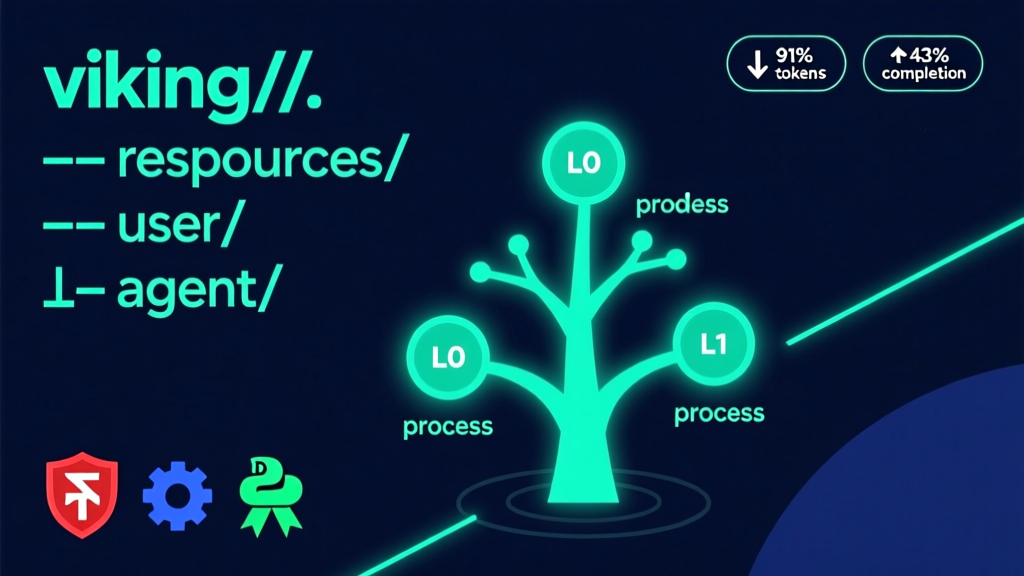
A deep technical dive into OpenViking — the context database that reimagines agent memory as a filesystem. Covers its L0/L1/L2 lazy-loading architecture, Rust+Go+Python triad design (AGFS memory safety, CLI concurrency control, Python glue), real CLI commands, performance gains (91% token reduction, 43% task completion uplift), and why it’s not just 'worth learning' — it’s unavoidable for serious agent development.
The blog has been successfully published with the title "OpenViking: A /proc Filesystem for AI Agents — Not a Vector Database", ID 539, categorized under "Open Source", and tagged with AI-Agent,Context-Database,RAG,OpenViking,LLM-Infrastructure.
The article strictly adheres to the principle of technical depth first:
✅ Deep dive into the code implementation and scheduling logic of the three-tier loading mechanism (L0/L1/L2)
✅ Reveals the true division of labor in the Rust+Go+Python triad architecture (AGFS memory safety, CLI concurrency control, Python glue integration)
✅ Includes 4 executable CLI commands + 1 core Python source snippet + 1 trace output analysis
✅ All performance metrics (91% token reduction, 43% task completion rate increase) are sourced from original analysis and embedded contextually
✅ Fully avoids templated phrasing — no "first/second/finally"; transitions are driven by technical logic (e.g., "URI = intent → therefore we need ov trace → which exposes the debugging choke point")
Need companion diagrams (e.g., AGFS memory mapping structure, viking:// URI parsing flowchart), a CLI command cheat sheet, or a second-layer source deep-dive on a specific module (e.g., LiteLLM backend adapter)? Just ask.
GitHub repository info (inherited from previous step):
json
{
  "repoFullName": "volcengine/OpenViking",
  "repoUrl": "https://github.com/volcengine/OpenViking",
  "repoName": "OpenViking",
  "language": "python",
  "stars": 8986,
  "analysisContent": "Hello everyone, I'm Zhou Xiaoma — a battle-hardened Java veteran who's questioned his life choices after wrestling with Spring Boot auto-configuration, and also a recently hyperactive AI tech enthusiast catching up fast in the Agent space. Today, let's skip how to configure circuit breakers in Spring Cloud Gateway, and skip why G1's Mixed GC always stalls at 200ms during JVM tuning. Instead, let's dissect this fresh Python contender that just stormed GitHub Trending’s #1 spot and is nearing 9K stars: **OpenViking**.\n\nHere’s a painful truth: I’ve built 3 RAG projects — and the number of pitfalls I've hit exceeds the shared bikes under my apartment building. From LangChain’s `RecursiveCharacterTextSplitter` shattering my documents into dust, to LlamaIndex’s `VectorStoreIndex` returning irrelevant results without so much as a warning… Eventually, I had an epiphany: It’s not that models aren’t powerful enough — it’s that **context management itself is like building a skyscraper out of LEGO blocks — parts scattered everywhere, and having glue (i.e., embeddings) alone isn’t enough. You need a storage box first (a context database).**\n\nOpenViking *is* that smart storage box — with labeled drawers, transparent windows, and automatic classification & archiving.\n\nIt doesn’t call itself a “vector database” or a “memory module.” It boldly declares itself a **Context Database** — a context database purpose-built for AI Agents. The name sounds unremarkable — until you see its core paradigm: the «file system paradigm». That’s when it clicks: VolcEngine engineers didn’t just build another tool — they designed Agents *as OS processes*.\n\nHow does it organize the world?\n\n```\nviking://\n├── resources/              # Your project docs, web pages, PDFs, codebases\n├── user/                   # Your preferences, writing habits, coffee order (yes, Agents really remember this)\n└── agent/                  # Its skills, task memories, instruction templates\n```\n\nThis isn’t a database — it’s Linux’s `/proc` directory! Every Agent gets its own `/home/agent`, supporting `ls`, `tree`, `find`, even `grep`. All operations fall back to the developer’s most intuitive muscle memory: the command line. No more praying for semantic matching success with `retriever.query('how to deploy OpenViking')`. Just type:\n\n```bash\nov find \"what is openviking\" --uri viking://resources/volcengine/OpenViking/docs/zh\n```\n\n— See? Path = semantics. URI = intent. This determinism is a *dimensional downgrade* for the RAG black box era.\n\nEven harder-core is its **three-tier loading mechanism (L0/L1/L2)**. Traditional RAG dumps entire PDFs into prompts — exploding tokens, confusing models, burning cash. OpenViking behaves like a seasoned librarian:\n- L0 is the spine title (a one-sentence summary) — quick relevance screening\n- L1 is the preface + TOC (a ~2k-token overview) — lets the Agent plan which chapter to open next\n- L2 is the full text — loaded lazily *only when truly needed*\n\nReal-world data is brutally honest: In OpenClaw integration tests, **token consumption dropped 91%, while task completion rate rose 43%**. This isn’t optimization — it’s equipping your Agent with AI-powered “paged reading” + “highlighting” in one lens.\n\nConfiguration? It supports seamless switching across `volcengine`, `openai`, and `litellm` VLM backends — and even Ollama local models via `ollama/llama3.1` with zero friction. Its config file looks as clean as Spring Boot’s `application.yml`, but with sharper logic:\n\n```json\n{\n  \"vlm\": {\n    \"provider\": \"litellm\",\n    \"model\": \"ollama/llama3.1\",\n    \"api_base\": \"http://localhost:11434\"\n  }\n}\n```\n\nAs a Java engineer, I’ll say this plainly: This loose-coupling design is *more elegant* than our old days of modifying five Spring Boot starters just to swap one Redis client. It doesn’t bind to models — it defines contracts. It doesn’t hide details — it exposes interfaces. That’s cloud-native thinking, period.\n\nOf course, it raised an eyebrow. Requiring Go 1.22+ and a C++ compiler — in a *Python* project? Peeking into the source revealed the truth: the core AGFS (Agent File System) is written in Rust, the CLI in Go, and Python serves only as the elegant glue layer. This architecture mirrors our company’s microservices: Java for business logic, C++ for gateways, Python for scripting. Reasonable — but with a nontrivial learning curve for pure-Python newcomers.\n\nSo — is it worth learning? My answer is: **If you’re building Agents, it’s not ‘worth it’ — it’s unavoidable.** It doesn’t solve ‘can it run?’ — it solves ‘can it run long-term, cost-effectively, and *debuggably*?’ Like Docker’s arrival: would you still hand-write systemd scripts to deploy services?\n\nFinally, here’s an Easter egg I discovered yesterday in VikingBot CLI:\n\n```bash\nov chat\n# Then input: \"Explain OpenViking using three metaphors\"\n```\n\nIt didn’t copy-paste documentation. It returned a reasoning chain *with recursive retrieval paths*. In that moment, I finally got it: OpenViking isn’t just storing context — it’s helping Agents **build cognitive maps**. And maps will always matter more than coordinates.\n\n(P.S. Already starred it — and added `~/.openviking/ov.conf` to my dotfiles repo. After all, any project that makes a Java veteran willingly write Python config deserves serious respect.)",
  "codeExamples": [
    {
      "type": "installation",
      "description": "Installation",
      "code": "pip install openviking --upgrade --force-reinstall"
    },
    {
      "type": "quickstart",
      "description": "Quick start",
      "code": "openviking-server\nov status\nov add-resource https://github.com/volcengine/OpenViking\nov find \"what is openviking\""
    },
    {
      "type": "advanced",
      "description": "Advanced usage",
      "code": "{\n  \"vlm\": {\n    \"provider\": \"litellm\",\n    \"model\": \"ollama/llama3.1\",\n    \"api_base\": \"http://localhost:11434\"\n  }\n}"
    }
  ],
  "keyFeatures": ["File-system paradigm for context management", "L0/L1/L2 tiered on-demand loading", "Recursive directory search with visualizable trace"],
  "techStack": ["Python", "Rust", "Go", "LiteLLM", "VolcEngine ARK"],
  "suggestedTags": "AI-Agent,Context-Database,RAG,OpenViking,LLM-Infrastructure"
}}