Spacedrive: A Virtual Distributed File System Built with Rust
Spacedrive reimagines file management by creating a virtual distributed filesystem (VDFS) that unifies files across all your devices without moving them. Built in Rust, it leverages content-addressing, serverless P2P sync, WASM extensions, and offline-first design—ideal for privacy-conscious multi-device users and distributed systems enthusiasts.
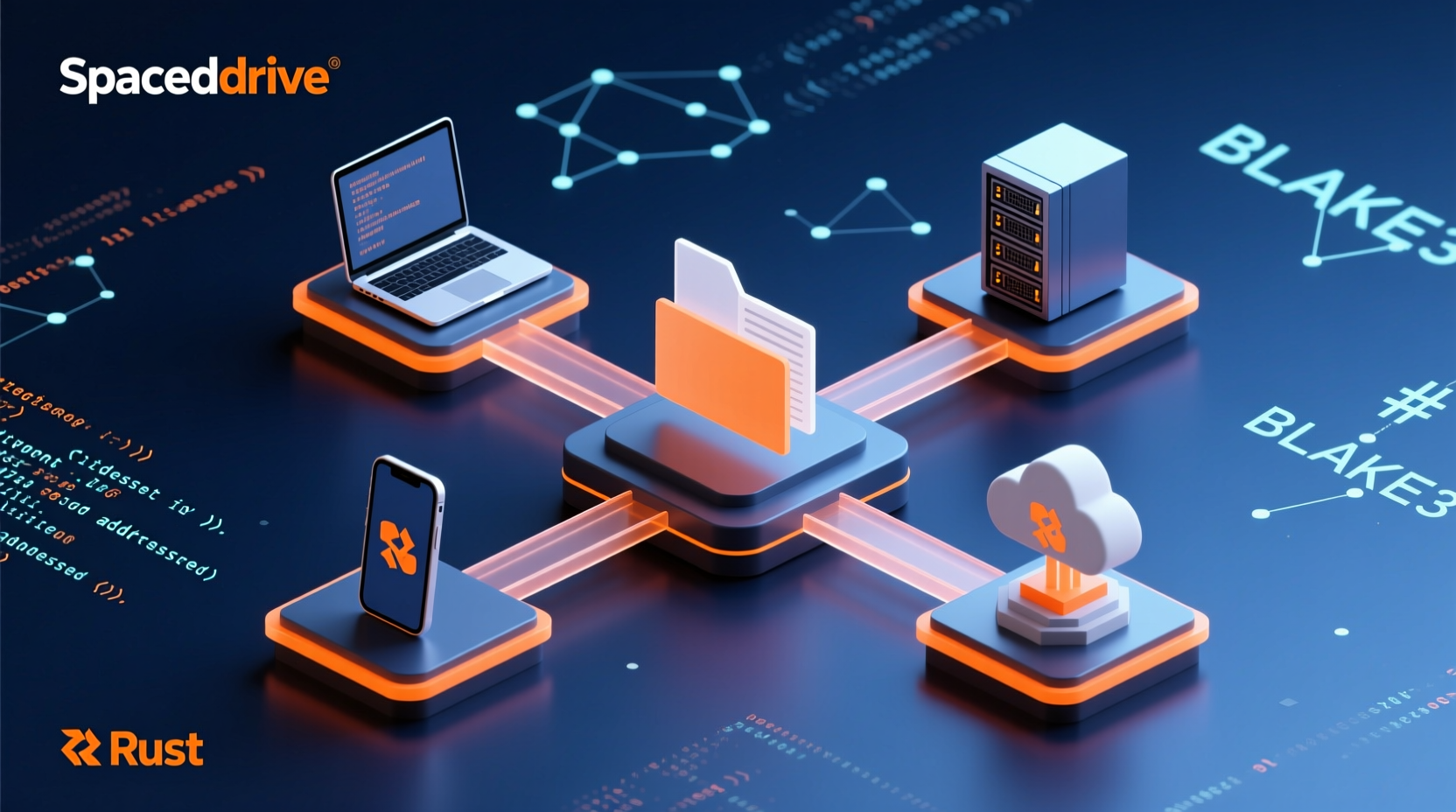
As a Java veteran who’s endured eight years of the Spring ecosystem, I nearly spat my coffee onto my keyboard when I first saw Spacedrive—this isn’t just another file manager; it’s a bold prescription for modern multi-device life!
What Problem Does It Actually Solve?
Picture this: your work documents live on your laptop, thousands of photos clutter your phone, movies are stored on your NAS, and backups sit in the cloud. Traditional file managers (Finder, Explorer) act like isolated islands—you must remember exactly where each file resides. Spacedrive’s idea is delightfully radical: make all your files across every device appear as if they’re in one unified place.
It doesn’t simply sync files to the cloud (which would surrender your data sovereignty). Instead, it builds a “Virtual Distributed File System” (VDFS). Files stay physically where they are, but Spacedrive uses content hashing to recognize identical files, letting you access the optimal copy from any device. Think of it like your home Wi-Fi: whether you’re in the living room or bedroom, you’re connected to the same network—but your router and devices never move.
How Hardcore Is the Technical Architecture?
Let me, a Java developer, break down this Rust project’s architecture:
1. Content Identity
Every file gets a unique fingerprint via the BLAKE3 hash algorithm, with intelligent sampling for large files. Even if you copy a photo from your phone to your NAS and rename it, Spacedrive still recognizes it as the same file. BLAKE3 is significantly faster than legacy hashes like MD5 or SHA-1—and in the Rust ecosystem, it’s an outright performance beast.
2. Leaderless P2P Synchronization
No central server exists; devices communicate directly. Using the Iroh library, it implements QUIC transport and NAT traversal. This reminded me of etcd clusters from my microservices days—but here, everything is fully decentralized, even eliminating leader election. Conflicts are resolved using HLC (Hybrid Logical Clocks) to guarantee eventual consistency.
3. CQRS + Transaction Preview
This design speaks directly to my soul! All file operations follow the CQRS pattern: preview (Query) first, then execute (Command). For example, before deleting a file, the system tells you, “This file has backups on 3 devices; deletion will free 2GB of space.” Only after your confirmation does it actually run. This is even more user-friendly than database transactions.
4. WASM Extension System
The plugin system uses WebAssembly—secure, sandboxed, and cross-platform. Planned extensions like AI-powered photo management, knowledge graphs, and financial analysis all run in WASM sandboxes, leaving the core application untouched. This approach is even more lightweight than Java’s OSGi modularity.
What’s the Real-World Experience Like?
According to the README, the setup is fairly friendly for Rust developers:
bash
## Clone the repository
git clone https://github.com/spacedriveapp/spacedrive
cd spacedrive

## Install dependencies
bun install
cargo run -p xtask -- setup
cargo build

## Launch the desktop app
cd apps/tauri
bun run tauri:dev
Note: you’ll need both Rust (1.81+) and Bun (1.3+), which might be a hurdle for pure frontend or backend devs. But once it’s running, CLI usage is straightforward:
bash
## Start the daemon
cargo run -p sd-cli -- daemon start

## Create a library and add a location
cargo run -p sd-cli -- library create "My Library"
cargo run -p sd-cli -- location add ~/Documents

## Search files
cargo run -p sd-cli -- search .
What excites me most is its offline-first design. All features work perfectly without internet—and sync automatically once reconnected. As someone who often codes on high-speed trains, this is nothing short of a blessing!
Who Is This For?
- Tech Enthusiasts: Those eager to experience next-gen file management
- Privacy-Conscious Users: Anyone unwilling to hand all their data to cloud providers
- Multi-Device Users: People juggling Mac, Windows, Linux, iOS, and Android
- Developers: Those interested in distributed systems and P2P networking
The learning curve is moderately steep (you’ll need to compile a Rust project), but the authors provide full Docker support and thorough documentation.
My Personal Take
Honestly, as a Java backend engineer, I can’t help but feel a twinge of envy seeing such elegant systems-level software written in Rust. While Java boasts a vast ecosystem, it simply can’t match Rust’s elegance in systems programming. Spacedrive’s vision is ahead of its time—shifting file management from “path-oriented” to “content-oriented,” a trend likely to dominate the next decade.
If I were to adopt it at work, I’d use it as a team knowledge and asset management system. Imagine designers uploading PSDs, developers sharing code snippets, and product managers submitting requirement docs—all automatically deduplicated via content hashing and tagged to build a knowledge graph. That’s far more powerful than our current Confluence + cloud storage combo.
Is it worth deep study? Absolutely! Even if you never use Spacedrive itself, its architectural principles—local-first, content addressing, serverless sync—are invaluable for every backend developer. Especially in the AI era, Spacedrive offers a compelling answer to delivering intelligent services while preserving user privacy.
But let’s temper the hype: it’s still pre-release, so use caution in production. And Rust’s steep learning curve means Java-heavy teams might struggle with maintenance in the short term.