PaddleDetection: PaddlePaddle's Object Detection & Multi-Task Toolkit
PaddleDetection, developed by Baidu's PaddlePaddle team, is an object detection & multi-vision task toolkit supporting object detection, instance segmentation, multi-object tracking, etc., with 13.7k GitHub stars. Key strengths: industry-oriented, end-to-end training-to-deployment solutions, modular design for flexible components, and model zoo covering server-side (e.g., RT-DETR: 53.3% mAP, 78FPS on COCO) to mobile scenarios.
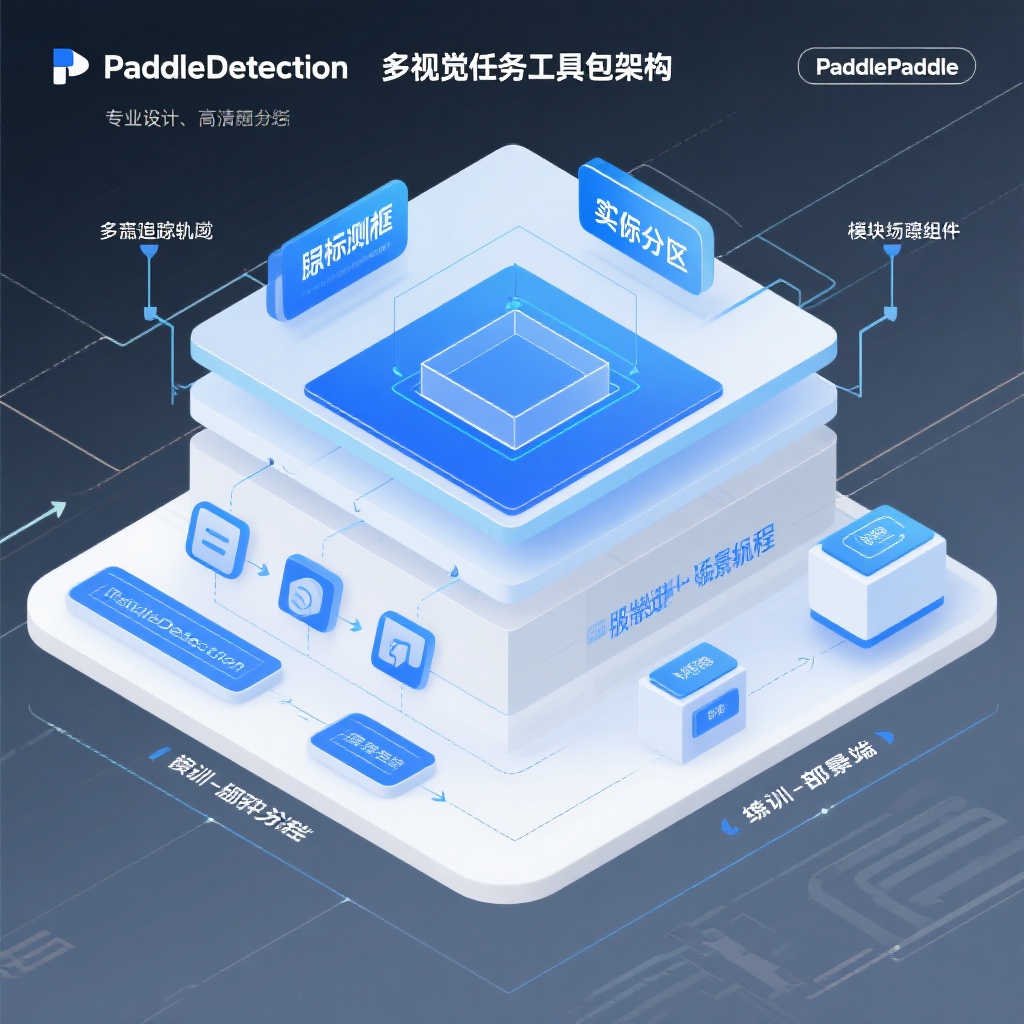
PaddleDetection: An End-to-End Toolkit for Object Detection
While reviewing open-source tools for object detection recently, I discovered PaddleDetection from Baidu's PaddlePaddle team. As a comprehensive toolkit focused on object detection, instance segmentation, multi-object tracking, and keypoint detection, it has accumulated 13.7k stars on GitHub, making it one of the more active projects in China's object detection domain. Unlike many frameworks that focus solely on model performance, PaddleDetection feels more oriented toward industrial implementation, addressing a range of practical issues from model training to deployment.
Core Features: Beyond Models, Focused on Implementation
PaddleDetection's core advantage lies not just in providing model implementations but in building a complete object detection development workflow. Its modular design allows developers to flexibly combine components like backbones, necks, and loss functions—similar to MMDetection but with the added benefit of built-in tools specifically designed for industrial scenarios.
The model library deserves special attention, covering full-scenario requirements from server-side to mobile applications. On the server side, there are high-precision models like PP-YOLOE+ and RT-DETR, where RT-DETR achieves 53.3% mAP on the COCO dataset at 78FPS, outperforming YOLOv8. For mobile applications, ultra-lightweight models like PP-PicoDet can run at 158FPS on Snapdragon 865 while maintaining good accuracy. This full-scenario coverage eliminates the need to switch between different frameworks, allowing developers to handle various hardware environments with a single tool.
Industry-specific tools are another highlight. PP-Human and PP-Vehicle, two ready-to-use analysis tools, impressed me: the former integrates pedestrian detection, attribute recognition, and behavior analysis (such as fall detection and fight recognition), while the latter focuses on vehicle detection, license plate recognition, and violation analysis. These aren't just simple demos but provide complete pre-trained models and deployment solutions, allowing enterprise developers to directly adapt them to their business scenarios and save significant customization time.
Technical Implementation: Balancing Accuracy and Engineering Implementation
From a technical perspective, PaddleDetection excels in both algorithm optimization and engineering implementation. Take the PP-YOLOE series as an example—it achieves a balance between accuracy and speed without using special operators like Deformable Convolution by introducing a scalable backbone (CRN), dynamic label assignment, and efficient loss function design. This practical design avoids the deployment challenges posed by special operators, which, while performance-enhancing, often have poor support on edge devices. PP-YOLOE's approach clearly prioritizes industrial requirements.
The integration of PaddleX, a low-code development tool, represents another significant advancement. It integrates 55 object detection and instance segmentation models into three production lines, providing a unified Python API and graphical interface that supports seamless switching between mainstream hardware (NVIDIA, Kunlun, Ascend, etc.). This greatly lowers the barrier for non-algorithm background developers while reducing repetitive engineering work for algorithm engineers.
Deployment support is equally comprehensive, covering everything from Python/C++ inference to Paddle Lite edge deployment and Paddle Serving for service-oriented deployment. Notably, its support for domestic hardware including Ascend and Cambricon provides a significant advantage given the growing demand for localization.
Comparison with Similar Projects: Different Strengths, Different Positions
There are several open-source tools in the object detection field, allowing for useful comparisons:
-
Compared with MMDetection: MMDetection focuses more on academic research with faster model updates and more paper reproductions, but offers relatively fewer industrial implementation tools. PaddleDetection takes the opposite approach—with a potentially less comprehensive model library but more mature industrial tools and deployment solutions, making it suitable for rapid implementation.
-
Compared with YOLO series (e.g., Ultralytics YOLOv8): The YOLO series focuses on achieving极致性能 for single models with significant advantages in lightweight design and speed, but offers relatively single functionality. PaddleDetection provides a more complete toolchain covering not just detection but also segmentation, tracking, and keypoint tasks, functioning more as an integrated platform.
-
Compared with Detectron2: Backed by Facebook, Detectron2 boasts high engineering quality but is less user-friendly for domestic users with limited Chinese documentation and poor support for domestic hardware. PaddleDetection naturally benefits from Chinese documentation and community support, with industrial cases more closely aligned with domestic scenarios.
Practical Experience and Application Scenarios
In practice, PaddleDetection truly lives up to its "ready-to-use" promise. Environment configuration proceeded smoothly following the official documentation—while requiring PaddlePaddle installation, it provides clear version compatibility instructions. The quick start tutorial is practical, allowing users to run prediction demos within 3 minutes, which is very beginner-friendly.
The data preparation phase offers detailed annotation format explanations and support for national standard datasets—crucial for enterprise users, as many real-world projects use non-standard data formats. Model training supports distributed training and mixed precision. Testing PP-YOLOE+ on V100 with 8 cards, the COCO dataset converged to approximately 5x mAP in about 2 days, consistent with the official performance data.
Regarding适用人群, it particularly suits two types of developers: enterprise teams needing rapid implementation of object detection projects, especially in scenarios like intelligent transportation, industrial quality inspection, and security monitoring; and developers with some algorithmic knowledge who want to reduce engineering work—tools like PP-Human and PP-Vehicle can be directly reused, saving significant development time.
Objective Evaluation: Advantages and Limitations
The advantages are clear:
- End-to-end coverage: From data preparation and model training to deployment, one tool handles everything, eliminating the hassle of switching between frameworks.
- Rich industrial tools: Ready-to-use toolkits like PP-Human and PP-Vehicle significantly lower the barrier for industrial implementation.
- Comprehensive deployment ecosystem: Supports full-scenario deployment from server to edge, with particularly strong support for domestic hardware.
- Chinese documentation and community: Friendly to domestic developers with relatively fast response times for GitHub issues.
Limitations should also be noted:
- Framework dependency: Requires PaddlePaddle, creating a switching cost for PyTorch习惯的 developers. While ONNX export is supported, the ecosystem richness is somewhat limited.
- Model update speed: Support for some latest academic models (e.g., YOLOv9) may lag behind MMDetection or official implementations.
- Customization flexibility: While the modular design offers flexibility, customizing complex models may be slightly more cumbersome compared to MMDetection's configuration system.
Conclusion: A Practical Choice Worth Trying
Overall, PaddleDetection is a pragmatic object detection toolkit. It may not be the most cutting-edge academic research tool, but it is definitely a valuable assistant for industrial implementation. If you need to quickly apply object detection technology to practical projects—especially those involving intelligent transportation, industrial quality inspection, or security monitoring—it can save significant time in converting algorithms to products.
As a developer who regularly uses PyTorch, I find the industrial tool思路 provided by PaddleDetection quite insightful. Too often, we focus on model accuracy while overlooking engineering细节 during implementation, an area where PaddleDetection has done substantial practical work. If you're struggling with deploying and customizing object detection projects, PaddleDetection is worth trying—it might just solve many of your practical problems.