BAML AI框架:Rust构建的多语言类型安全提示工程开发实用工具,2025
BAML AI framework, a leading prompt engineering tool, transforms 2025 AI development with typesafe practices. Built for reliability in LLM interactions, this Rust-powered solution simplifies managing AI workflows, boasting 5,400+ GitHub stars. Explore how it streamlines typesafe AI development for robust applications.
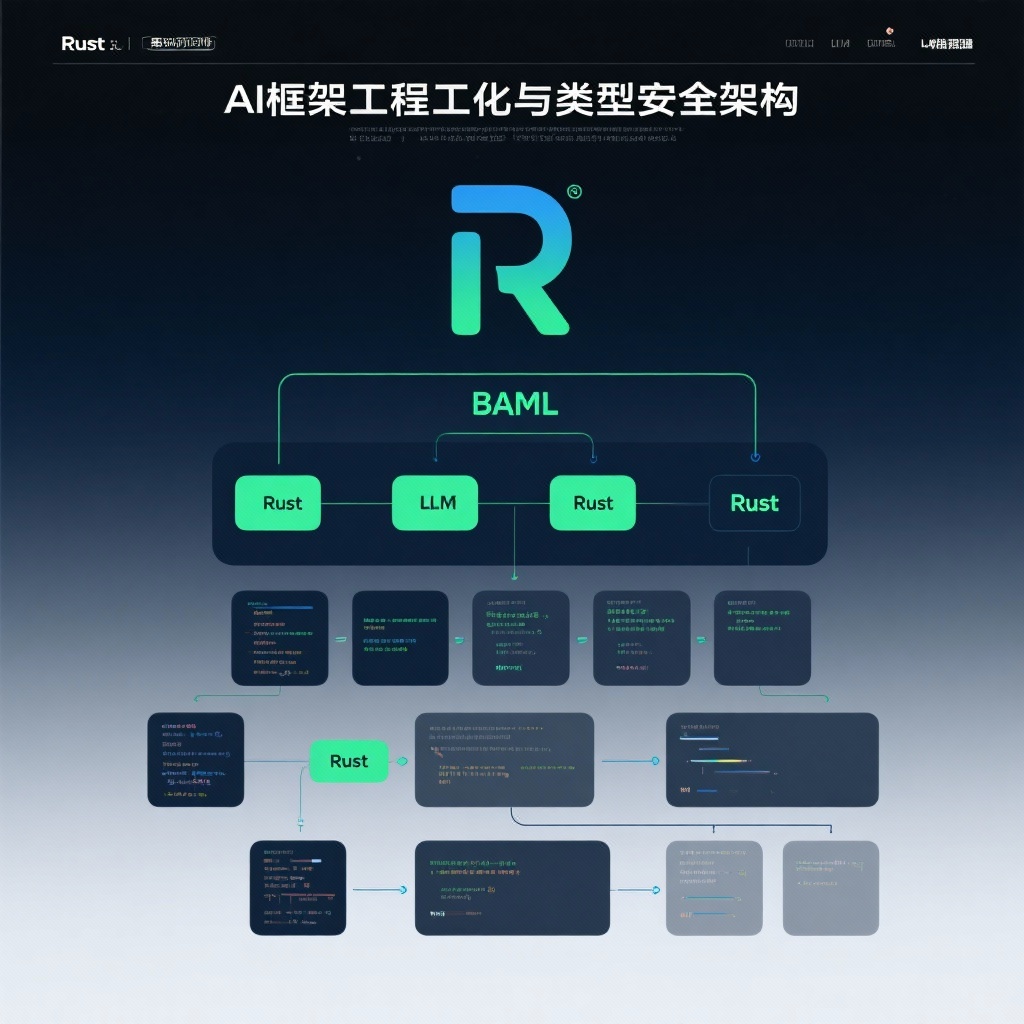
BAML AI Framework: Revolutionizing Prompt Engineering with Typesafe Development
In the rapidly evolving landscape of AI development, maintaining reliability and efficiency in LLM interactions has become increasingly challenging. Enter BAML AI framework – a game-changing prompt engineering tool that transforms how developers build and manage AI-powered applications. With over 5,400 stars on GitHub as of 2025, BAML (Basically a Made-up Language) has established itself as a leading solution for typesafe AI development, offering a structured approach to creating robust AI workflows and agents.
What is BAML and Why Does It Matter?
BAML is an open-source framework designed to bring much-needed engineering discipline to prompt engineering. Developed by BoundaryML and built with Rust, this innovative tool addresses the common pain points of working with large language models (LLMs), including inconsistent outputs, limited type safety, and cumbersome prompt management across multiple programming languages.
Unlike traditional methods that treat prompts as unstructured strings, BAML introduces the revolutionary concept of "schema engineering" – where developers focus on defining clear input/output models rather than wrestling with complex prompt templates. This paradigm shift not only improves reliability but also dramatically accelerates development cycles.
Key Features of BAML AI Framework
Typesafe AI Development
At the core of BAML's philosophy is the idea that LLM prompts should be treated as functions with defined parameters and return types. This approach enables typesafe AI development throughout the entire application lifecycle.
rust
function ChatAgent(message: Message[], tone: "happy" | "sad") -> StopTool | ReplyTool {
    client "openai/gpt-4o-mini"

    prompt #"
        Be a {{ tone }} bot.
        {{ ctx.output_format }}
        {% for m in message %}
        {{ _.role(m.role) }}
        {{ m.content }}
        {% endfor %}
    "#
}
This type safety extends beyond development, providing validation at runtime and ensuring consistent behavior across different LLM providers.
Multi-Language AI Tool Support
One of BAML's most compelling features is its extensive multi-language AI tool compatibility. While the framework itself is built in Rust, it generates native client libraries for Python, TypeScript, Ruby, Java, C#, Rust, and Go. This means developers can integrate BAML into their existing codebases regardless of the primary language.
Here's how straightforward it is to call a BAML function from Python:
python
from baml_client import b
from baml_client.types import Message, StopTool

messages = [Message(role="assistant", content="How can I help?")]

while True:
  print(messages[-1].content)
  user_reply = input()
  messages.append(Message(role="user", content=user_reply))
  tool = b.ChatAgent(messages, "happy")
  if isinstance(tool, StopTool):
    print("Goodbye!")
    break
  else:
    messages.append(Message(role="assistant", content=tool.response))
Powerful AI Workflow Builder
BAML shines as an AI workflow builder, enabling developers to create complex agent behaviors with minimal code. By chaining BAML functions together, you can build sophisticated AI agents that maintain state, make decisions, and interact with external systems seamlessly.
The framework's streaming capabilities further enhance this functionality, allowing for real-time interactions with partial results:
python
stream = b.stream.ChatAgent(messages, "happy")
for tool in stream:
    if isinstance(tool, StopTool):
        ...
final = stream.get_final_response()
LLM Tool Calling Reinvented
BAML revolutionizes LLM tool calling with its innovative Schema-Aligned Parsing (SAP) algorithm. This technology enables reliable tool calling even with models that don't natively support function calling APIs. SAP handles the flexible outputs LLMs often provide, including markdown within JSON blobs or chain-of-thought reasoning before final answers.
This capability ensures your applications remain functional across different LLM providers and versions, eliminating the need to rewrite prompts when switching models.
Enhancing Developer Experience
Rapid Prompt Iteration
BAML dramatically speeds up development with its integrated testing tools. The framework's VSCode extension allows developers to visualize full prompts, test different scenarios, and see API requests without leaving their IDE. This reduces testing cycles from minutes to seconds, enabling hundreds of iterations in the time it would take to test just a handful of ideas with traditional methods.
Model Flexibility
Switching between LLM providers or models is as simple as changing a single line of code in BAML. The framework supports all major providers including OpenAI, Anthropic, Gemini, Vertex, Bedrock, and Azure OpenAI, as well as open-source models through Ollama, VLLM, and LMStudio.
diff
function Extract() -> Resume {
+  client openai/o3-mini
  prompt #"
    ....
  "#
}
BAML also provides advanced strategies like retries, fallbacks, and model rotations, all defined statically within your BAML files.
Real-World Applications of BAML
Building AI Agents
As an AI agent framework, BAML excels at creating persistent AI entities that can maintain context, make decisions, and interact with users or other systems over extended periods. The combination of type safety, streaming, and tool calling makes implementing complex agent behaviors straightforward.
Schema Engineering for AI
BAML's approach to schema engineering AI has proven particularly valuable in data extraction, classification, and transformation tasks. By defining clear output schemas, developers can ensure consistent results even when processing unstructured text from diverse sources.
Enterprise Integration
Companies across industries have adopted BAML for its reliability, performance, and security features. The framework's offline capabilities ensure sensitive data never leaves your infrastructure, while its Rust foundation provides the performance needed for high-volume applications.
Getting Started with BAML
To begin using BAML in your projects, visit the official documentation and follow the installation guides for your preferred language. The project's GitHub repository contains numerous examples and templates to help you hit the ground running.
For those new to the framework, the Prompt Fiddle web interface provides an excellent way to experiment with BAML's syntax and capabilities without any local setup.
Conclusion
BAML represents a significant step forward in making AI development more reliable, efficient, and accessible. By treating prompts as functions and focusing on schema engineering, this powerful Rust AI framework addresses many of the fundamental challenges faced by developers working with LLMs.
Whether you're building simple chatbots or complex AI agents, BAML's combination of type safety, multi-language support, and powerful tooling makes it an invaluable addition to any AI developer's toolkit. As the field of AI continues to evolve, frameworks like BAML will play an increasingly important role in bridging the gap between research and production.
To learn more about BAML and join the growing community of developers using this innovative framework, visit the GitHub repository or join the official Discord community.